
Ensayos
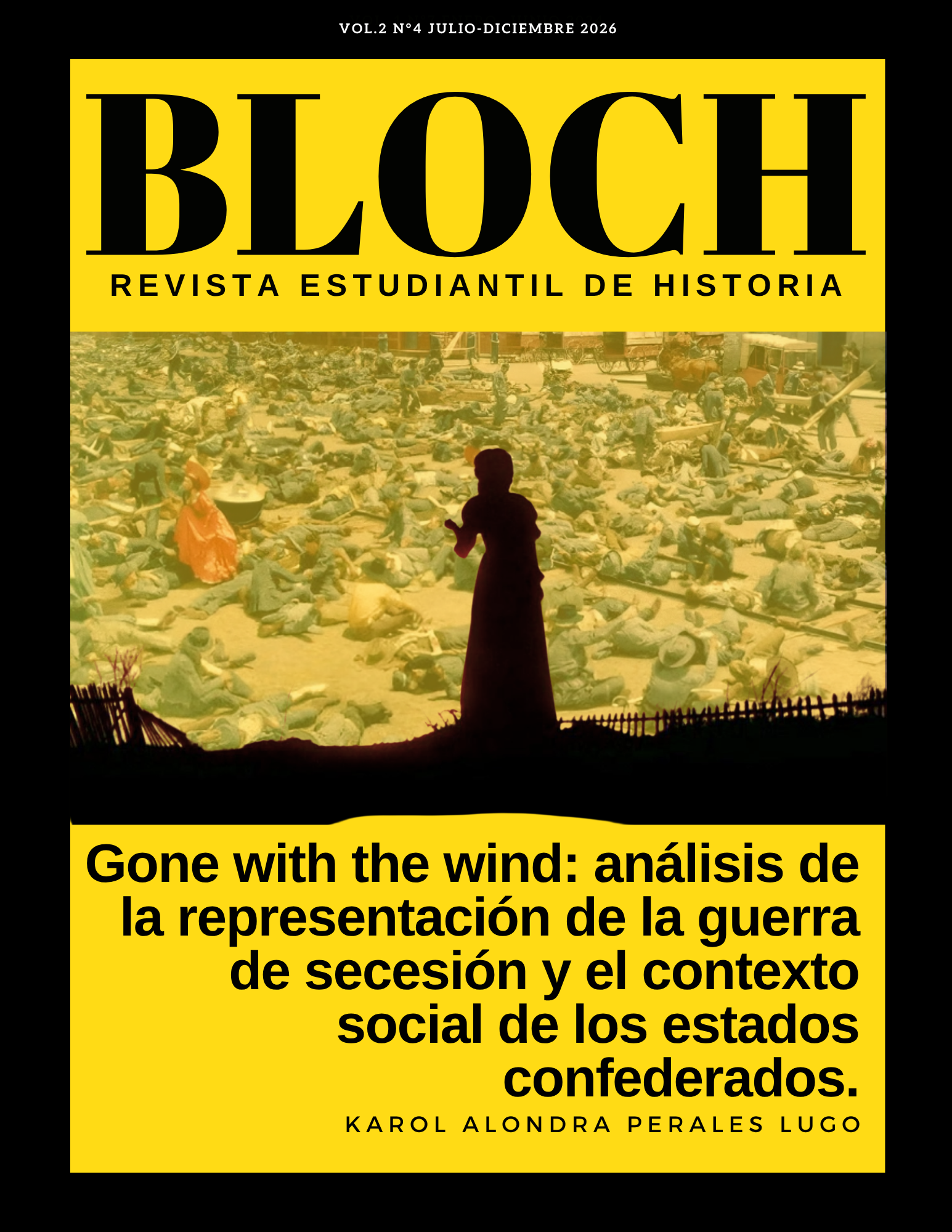
Gone with the Wind: An Analysis of the Depiction of the Civil War and the Social Context of the Confederate States
Published 2026-11-03
Keywords
- Historical accuracy,
- Gone with the Wind,
- Civil War,
- Confederate states,
- Identity
How to Cite
Perales Lugo, Karol Alondra. 2026. “Gone With the Wind: An Analysis of the Depiction of the Civil War and the Social Context of the Confederate States”. Bloch. Revista Estudiantil De Historia 2 (4):74-82. https://revistabloch.uanl.mx/index.php/b/article/view/216.
Copyright (c) 2026 Karol Alondra Perales Lugo

This work is licensed under a Creative Commons Attribution 4.0 International License.
Abstract
This essay aims to analyze the depiction of the American Civil War and the social context of the Confederate States through the film Gone with the Wind. Specifically, it seeks to understand the work's context and highlight the characteristics of the affluent Southern society that drove the Confederate cause, while also examining the film's historical accuracy by comparing its screenplay with historiographical sources, particularly Aurora Bosch’s Historia de los Estados Unidos 1776–1945. Although this study does not focus primarily on the institution of slavery, the analysis identifies historical elements that align with reality, such as the economic importance of plantations, Southern identity and pride, and the impact of pivotal military events like the Battle of Gettysburg and Sherman’s advance through Georgia. It highlights that the film presents a romanticized, idealized vision of the Confederacy, particularly regarding economic recovery and slavery, by employing stereotypes that downplay the violence of the era. Finally, the text concludes that the film played a decisive role in shaping the collective imagination regarding the "Old South" and the historical memory of the American Civil War.Downloads
Download data is not yet available.
References
- Ayers, Edward L. y John C. Willis. The Edge of the South: Vida en la Virginia del Siglo XIX, University Press of Virginia (1991).
- Selznick, David O. “Gone with the wind”, dirigido por Victor Fleming, 15 de diciembre de 1996 (Selznick International Pictures, 1939), Amazon prime.
- Bosch, Aurora. Historia de los Estados Unidos 1776-1945 (Barcelona: Critica, 2005).
- Caparrós-Lera, José. “La Guerra Civil estadounidense vista por el cine”, Universidad de La Sabana 12, núm. 2 (2009): 195-206. http://www.redalyc.org/articulo.oa?id=64912212002
- Eaton, Clement. A history of the Old South The Macmillan Company, 1949. https://archive.org/details/historyofoldsout0000eato/page/n5/mode/2up.
- Hijano, Angela. “la guerra de secesión estadounidense: ¿la solución de un problema político?” Universidad Autónoma de Madrid, núm. 13 (1997): *La_20Guerra_20de_20Secesi_C3_B3n_20Estadounidense._20La_20Soluci_C3_B3n_20de_20un_20Problema_20Pol_C3_ADtico-libre.pdf
- Howard, Sidney. Gone With the wind: foreword title, Estados Unidos: Selznick international, 1939. gone-with-the-wind-1939.pdf
- Nevins, Allan y Henry Stelle. Breve historia de los Estados Unidos: la herencia colonial México: Fondo de cultura económica, 1994.
- López, María, Ruth Morales y Alberto Moreno. “Reconfiguración identitaria en procesos migratorios: el debate teórico interdisciplinario. Realidades, impactos y desafíos.” Universidad del Zulia 26, núm. 106 (2024): https://www.redalyc.org/journal/279/27980010002/html/
- Nevins, Allan y Stelle, Henry. Breve historia de los Estados Unidos: Herencia colonial México, Fondo de cultura económica, 1994.