
Artículos de investigación
From vagrant to slave: the criminalization of vagrancy and the use of forced labor as punishment in colonial Mexico during the 17th and 18th centuries
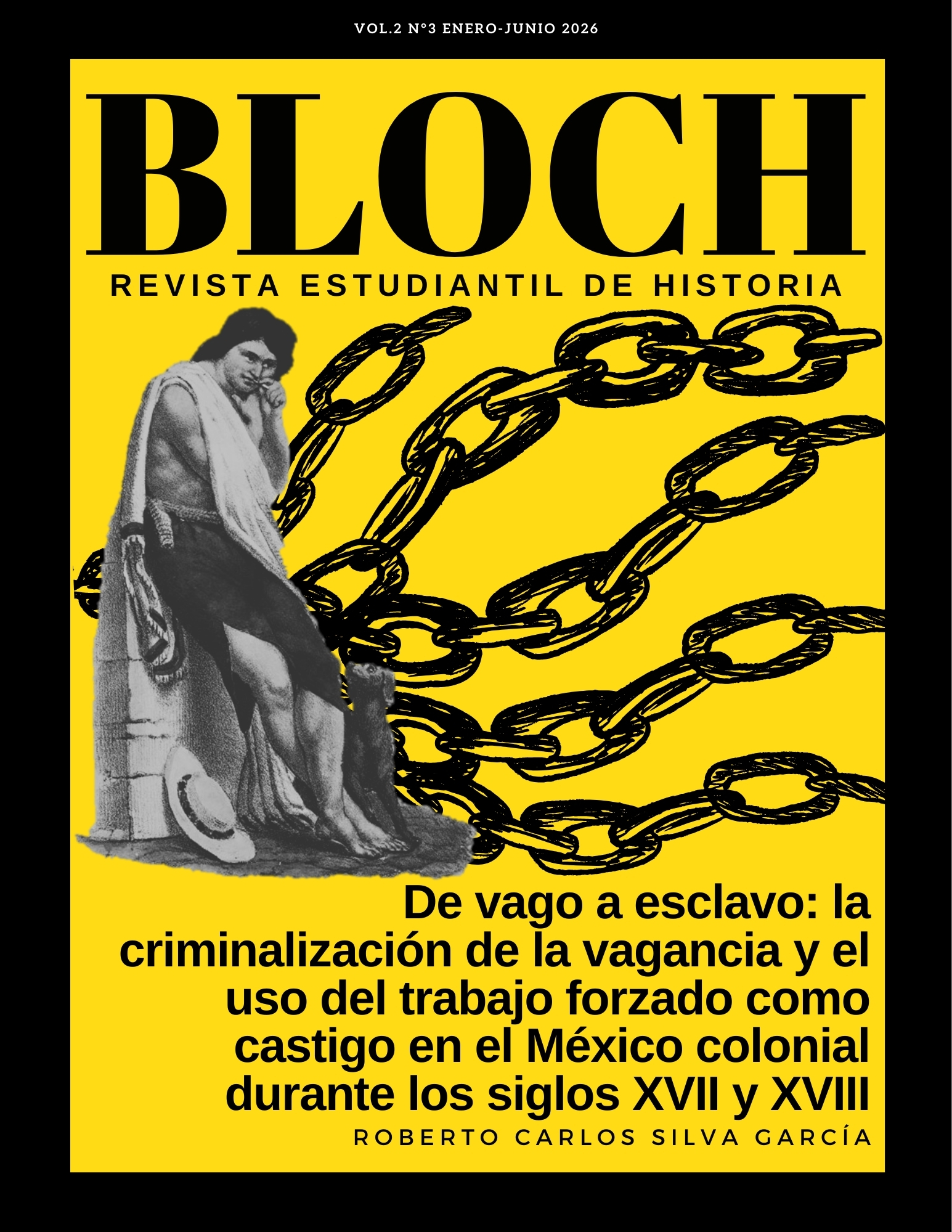
Published 2026-03-11
Keywords
- Keywords: Vagrancy; mendicancy; social control; criminalization; forced labor.
How to Cite
Silva Garcia, Roberto Carlos. 2026. “From Vagrant to Slave: The Criminalization of Vagrancy and the Use of Forced Labor As Punishment in Colonial Mexico During the 17th and 18th Centuries ”. Bloch. Revista Estudiantil De Historia 2 (3):78-90. https://revistabloch.uanl.mx/index.php/b/article/view/208.
Copyright (c) 2026 Roberto Carlos Silva Garcia

This work is licensed under a Creative Commons Attribution 4.0 International License.
Abstract
The phenomenon of vagrancy and mendicancy during the seventeenth and eighteenth centuries in the outskirts of Mexico City constituted a social problem that had significant repercussions for the establishment and maintenance of the colonial order. This paper analyzes the emergence of the figure of the “vagrant” in New Spain, as well as the causes that led to the development and expansion of this phenomenon. The research is based primarily on the analysis of specialized bibliographic and electronic sources, as well as on primary documentation from the Archivo General de la Nación (AGN), which allows for a broader and more comparative approach to the issue under study. The results of the research indicate that vagrancy in the seventeenth and eighteenth centuries in the areas surrounding Mexico City was not merely a problem of idleness, but also one rooted in the structure of colonial society, where social mobility and advancement for the most vulnerable groups were virtually nonexistent. Furthermore, forced labor was used as a form of punishment to maintain social control over poor and marginalized populations.Downloads
Download data is not yet available.
References
- Archivo General de la Nación
- Arrom, Silvia M. s. f. “Vagos y mendigos en la legislación mexicana, 1745-1845.” En Memoria del IV Congreso de Historia del Derecho Mexicano (1986), editado por Beatriz Bernal. México: UNAM, Instituto de Investigaciones Jurídicas, 1988. http://ru.juridicas.unam.mx/xmlui/handle/123456789/9691
- Gómez González, Rosa María “Vagos y mendigos en la ciudad de México a fines de la Colonia” Iztapalapa 44 (1998) 135-158. https://revistaiztapalapa.izt.uam.mx/index.php/izt/article/view/1392
- Maldonado Ojeda, Luis M. 2003. “El Tribunal de Vagos de la Ciudad de México del siglo XIX. Una introducción.” Antropología. Revista Interdisciplinaria del INAH 70: 2–19. https://revistas.inah.gob.mx/index.php/antropologia/article/view/3032
- Martin, Norman F. “Los vagabundos en la Nueva España: Siglo XVI”, Tesis de Maestría, UNAM, 1957 Capítulo 1 y 2. http://ru.atheneadigital.filos.unam.mx/jspui/handle/FFYL_UNAM/4507
- Martin, Norman F. 1985. “Pobres, mendigos y vagabundos en la Nueva España, 1702-1766: antecedentes y soluciones presentadas.” Estudios de Historia Novohispana 8 (008). https://doi.org/10.22201/iih.24486922e.1985.008.3285
- Moreno Cabanillas, Rocío. s. f. Las reformas borbónicas. Ideimand. Universidad de Almería. https://www2.ual.es/ideimand/las-reformas-borbonicas/
- Ramos Vásquez, Isabel. “Policía de vagos para las ciudades españolas del siglo XVIII.” Revista de Estudios Histórico-Jurídicos no. 31 (2009). Recuperado de: https://www.rehj.cl/index.php/rehj/article/view/514
- Rojas Sosa, Odette María. 2023. “Una lacra social y un peligro: vagancia y malvivencia en la ciudad de México, 1931-1937.” Secuencia (115): e2011. Publicado el 17 de marzo de 2023. https://doi.org/10.18234/secuencia.v0i115.2011
- Von Mentz, Brígida. “Plata y sociedad regional. Reales de minas pequeños en la Nueva España, siglos XVI–XVIII.” Nuevo Mundo Mundos Nuevos (2015). https://doi.org/10.4000/nuevomundo.67733